
Abstract:
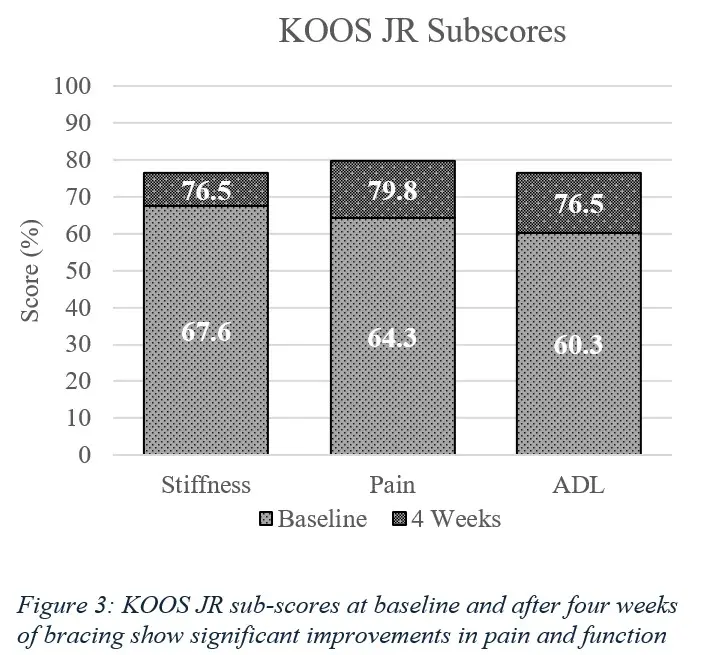
Knee osteoarthritis (KOA) is a widespread, debilitating disease; however, the current treatment options either increase risk of complications or reflect mixed efficacy in pain reduction. Patients need new solutions to address the biomechanical challenges posed by uni-compartmental KOA. This pilot study evaluated the clinical outcomes and patient compliance associated with a novel joint distraction unloading orthosis, the Adonis, aiming to assess its potential as a non-invasive alternative to early surgical intervention. 15 patients (17 knees) wore braces for four weeks, providing prospective baseline and four-week VAS and KOOS JR surveys to assess pain, function, and activity. Patients reported significant reductions in VAS pain (57% reduction from 5.18±1.55 to 2.24±1.52), and KOOS JR sub-scores (Pain: 64.3% to 79.8%, ADL: 60.3% to 75.5%). 100% of patients wore their brace at least weekly, 53% of the patients wore their brace every day, and 80% wore their brace for at least four days a week. Greater improvements in VAS and KOOS JR Pain and Activities of Daily Life (ADL) were correlated with higher patient compliance, suggesting a continued incentive for patients to regularly wear the brace long-term. Pilot outcomes on joint distraction bracing demonstrate improved outcomes and compliance over the current body of evidence surrounding traditional unloader braces. Future work should examine outcomes in large-scale, randomized, controlled trials to determine potential benefits relative to other conservative methods, and the potential for delaying the need for surgical intervention, as well as post operative applications.

Introduction:
Knee osteoarthritis is a leading cause of chronic pain and mobility limitation, significantly reducing quality of life for around 33 million individuals in the US, according to data from the Center for Disease Control and Prevention. Once symptoms or cartilage loss become too severe, the primary treatment recommended is total knee arthroplasty (TKA). However, as many as 37% of knee OA patients are not strong candidates for surgery, while others will aim to delay this surgery due to its invasiveness, cost, and recovery demands or be placed on long wait lists for TKA, resulting in prolonged discomfort with limited treatment options1.
Effective conservative treatment modalities are lacking. Three-point unloader braces use two points to pull the thigh and calf on the affected side. In doing so, the third point, placed on the knee joint, is leveraged to press on the non-affected side and create joint unloading. While theoretically feasible, there is little evidence demonstrating the load reduction of in vivo knee compartments. The braces consequently provide mixed results in pain reduction and function improvement2. This partly explains the poor user compliance in addition to bulkiness and poor aesthetics, with some studies reporting user compliance as low as 25% following one year from fitting2. Therefore, KOA patients require effective, conservative alternatives while waiting on a surgical intervention.
Joint distraction bracing takes a more targeted approach to unloading the knee. Rather than relying solely on a 3-point force generated by straps, joint distraction braces incorporate a unique hinge, which expands during gait to generate a significant axial force directly across the joint. The combination of the extending hinge mechanism, paired with geometric wedging and a high-friction silicone interface with the leg, results in a targeted axial force to unload the affected compartment.
The objective of this study is to observe the impact of joint distraction bracing on patient-reported outcomes for symptom alleviation and improved daily function.
Methods:
Patients with medial or lateral tibiofemoral OA diagnoses were fitted with a joint distraction brace, the Adonis by Icarus Medical. Patients reported outcomes through electronic surveys before receiving the brace and after four weeks of wearing the brace. The outcomes focused on validated measures of knee function, pain, and overall health using the Visual Analog Scale (VAS) and Knee Injury and Osteoarthritis Outcome Score for Joint Replacement (KOOS JR). Significance was determined for each method using the Mann–Whitney U test for group comparison (ɑ = 0.05). Compliance data were also analyzed to determine user adherence.

Results:
Preliminary data (n= 15 patients, 17 knees) showed a significant 57% decrease in VAS pain (5.18±1.55 before vs. 2.24±1.52 after four weeks of brace, p<0.0001) (Figure 2). The KOOS JR Pain scores significantly improved from 64.3% to 79.8% after four weeks of brace wearing (p<0.01). The KOOS JR Stiffness score improved from 67.6% to 76.5% but did not reach statistical significance. The KOOS JR ADL score significantly improved from 60.3% to 75.5% (p<0.05). 53% of the patients wore their brace every day, while 80% wore their brace for at least four days a week (Figure 2). Greater improvements in VAS scores were strongly correlated with increased brace usage (R2 = 0.81), and KOOS Pain and ADL were moderately correlated with increased brace usage (R2 = 0.43 and R2 = 0.56 respectively). 80% of users reported an improved perception of quality-of-life, and 73% reported either increased or significantly increased weekly activity levels after the four weeks. Of the users that knee replacement or knee surgery has been recommended to, 67% of them reported being able to delay their operations due to improved pain and function while the remaining 37% had not yet determined whether they would delay their surgery. Additionally, all patients who reported taking pain medication solely to manage their knee pain noted a decreased or significantly decreased consumption rate between the pre- and post-brace periods.
Discussion:
The results of this pilot study provide strong motivation for the broader study of outcomes and applications of the first-of-its-kind joint distraction brace. 71%, 59%, and 76% of users surpassed the threshold for clinically important differences in VAS, KOOS Pain, and KOOS ADL respectively, demonstrating the value of this technology in meaningfully impacting the lives of TF OA patients without requiring invasive procedures3.
These initial results are promising, considering that joint distraction has previously been a focus of surgical innovations rather than conservative ones. Knee joint distraction surgery, and recently available implantable shock absorbers (MISHA knee system) have been employed in KOA treatment, offering benefits of pain reduction and functional improvements. However, these methods present surgical risks, including infection, and face variable insurance coverage4. By applying joint distraction through this novel bracing approach, patients may yield some significant benefits with substantially lower risk and cost. Furthermore, the device may have applications as a low-risk predictor of surgical success with invasive distraction procedures if patients respond well to treatment.
Data indicating 100% user compliance during the study period, with most patients wearing their brace at least four times per week, indicates a major improvement in the state of bracing technology. This highlights the potential for a larger portion of patients to continue using the Adonis in long-term cases, which has not been supported in previous literature around unloader braces5. Further research can investigate long-term compliance and strategies to improve weekly wear frequency.

Considering the small sample size and limited time scale in this pilot study, future research will focus on exploring outcomes in a well-powered, randomized controlled trial over an extended period to validate the long-term impact and compliance associated with joint distraction bracing. Current understanding of distraction mechanism combined with this early data indicates promise for this technology for applications to unload or protect the meniscus post-injury or post-operation. More research is needed to explore further innovations in this space.
Conclusion:
Pilot study results indicate that the Adonis brace significantly reduced knee pain while improving function, quality of life, and activity in patients with TF OA. The average KOOS JR pain sub-score offers nearly double the improvement cited in previous studies for standard-of-care uni-compartment unloader braces6. These results support the orthosis as an effective method to improve the lives of TKA candidates while deciding on surgical management.
Bibliography:
1. Cooper, G. M., Bayram, J. M. & Clement, N. D. The functional and psychological impact of delayed hip and knee arthroplasty: a systematic review and meta-analysis of 89,996 patients. Sci Rep 14, 8032 (2024).
2. Hetherington, S., Watson‐Smith, S., Evison, F. & Miller, C. Knee Bracing for Unicompartmental Osteoarthritis: A Service Evaluation. Musculoskeletal Care 23, e70072 (2025).
3. Silva, M. D. C., Perriman, D. M., Fearon, A. M., Couldrick, J. M. & Scarvell, J. M. Minimal important change and difference for knee osteoarthritis outcome measurement tools after non-surgical interventions: a systematic review. BMJ Open 13, e063026 (2023).
4. Diduch, D. R., Crawford, D. C., Ranawat, A. S., Victor, J. & Flanigan, D. C. Implantable Shock Absorber Provides Superior Pain Relief and Functional Improvement Compared With High Tibial Osteotomy in Patients with Mild-to-Moderate Medial Knee Osteoarthritis: A 2-Year Report. Cartilage 14, 152–163 (2023).
5. Squyer, E., Stamper, D. L., Hamilton, D. T., Sabin, J. A. & Leopold, S. S. Unloader knee braces for osteoarthritis: do patients actually wear them? Clin Orthop Relat Res 471, 1982–1991 (2013).
6. Petersen, W. et al. Non-operative treatment of unicompartmental osteoarthritis of the knee: a prospective randomized trial with two different braces—ankle–foot orthosis versus knee unloader brace. Arch Orthop Trauma Surg 139, 155–166 (2019)