The findings summarized in this technical brief have since been published as a peer-reviewed clinical study. Readers interested in the complete methodology, statistical analysis, and discussion can access the full publication HERE.
Authors: Andrew R. Phillips, M.D.; Thomas Moran, M.D.; Kofi K. Acheampong, M.D.; Stephanie A. Boden, M.D.; Erik C. Haneberg, B.S.; William D. Bugbee, M.D.; John P. Fulkerson, M.D.; Simon Goertz, M.D.; John G. Lane, M.D.; Sabrina M. Strickland, M.D.; and Adam B. Yanke, M.D., Ph.D.
 Abstract: This paper summarizes the clinical outcomes and compliance rates of a prospective study on a quadricep unloader brace in patients with patellofemoral osteoarthritis (PFOA), conducted by Rush University Medical Center in Chicago, IL, and the Division of Orthopaedic Surgery at Scripps Clinic in La Jolla, CA. 113 participants wore the brace for four weeks, reporting significant improvements in pain and function as measured by KOOS, JR. (63.8% improvement) and VAS pain scores (59.3% improvement). Of the 101 patients who initially reported moderate or worse stiffness, over half (54.5%) improved to mild or no symptoms. Notably, the brace used (custom Ascender knee brace by Icarus Medical) saw much higher compliance rates than traditional braces, with over half of patients wearing the brace at least four times per week. These results, among others, underscore the potential of PF-unloading braces as a non-invasive and effective approach for managing OA symptoms.
Introduction:
Knee osteoarthritis (OA) is a prevalent and debilitating condition, affecting over 14 million adults in the United States.1,2 In the knee, OA can be found in one or more compartments of the knee: the medial tibiofemoral compartment, lateral tibiofemoral compartment, and the patellofemoral compartment.
Among its various forms, patellofemoral OA (PFOA) is by far the most prevalent, accounting for a majority of symptomatic OA cases. Epidemiological studies indicate that over 50% of symptomatic OA cases involve the PF compartment.3 Studies on OA further corroborate this, where 94% of knee pain patients with radiographic OA involved the patellofemoral compartment. 59% of these had combined PF and TF OA, and 35% had isolated PFOA. Less than 6% of cases had isolated TF OA.4
PFOA, treatment options remain limited, especially for patients not suited for surgical interventions. Conservative management, including analgesics, injections, and physical therapy, can be effective but often comes with drawbacks such as variable efficacy and potential safety concerns—such as the relationship between higher dose corticosteroid injections and long-term cartilage damage and chondrocyte toxicity.5 Bracing offers a safer, conservative alternative with the potential for pain relief and functional improvement. However, traditional OA bracing has focused primarily on addressing medial and lateral TFOA.6 The utility bracing in improving PFOA symptoms has been insufficiently explored—this study investigates the impact of a novel patellofemoral unloader brace on symptom alleviation using patient-reported outcomes.
Methods:
This prospective study enrolled adults with a diagnosis of PFOA or multicompartment OA involving the patellofemoral joint. Patients were recruited for the four-week study continuously over a period of 3 years. They were fitted with a custom patellofemoral unloading knee brace, the Ascender by Icarus Medical. This brace is designed to reduce joint loading during activities requiring knee flexion, where patellofemoral pressure is significantly higher.7,8 Baseline surveys including the KOOS, JR. (Knee Injury and Osteoarthritis Outcome Score) and VAS (Visual Analog Scale) pain scale were collected prior to brace usage. Participants were instructed to wear the brace for four weeks, after which follow-up surveys were conducted to assess changes in pain, stiffness, and functional outcomes.
Results:
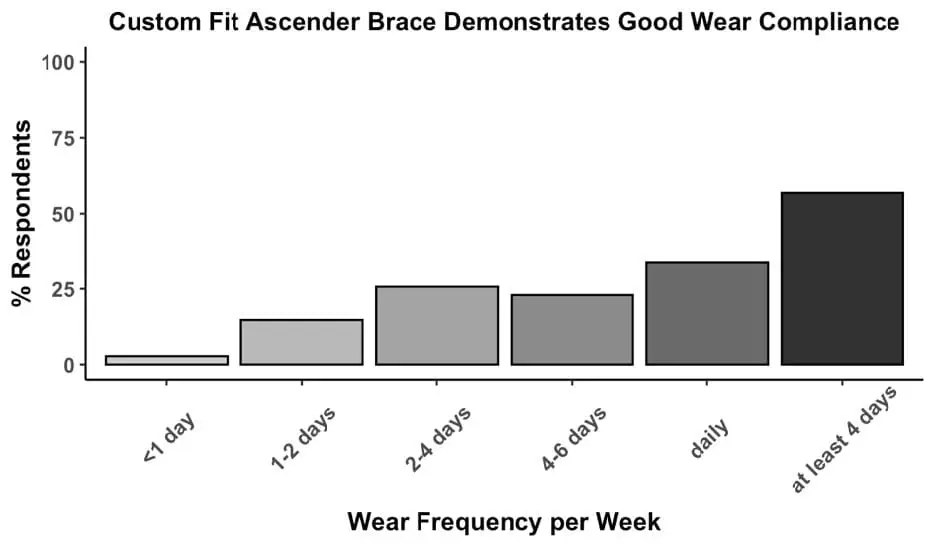
113 patients (134 knees) completed the four-week study survey. The mean age of participants was 53.5 years, with 43.4% identifying as female. Notably, compliance was high. 56.9% of participants wore the brace at least 4 times per week and 33.9% wore it daily; patients were not instructed on wear frequency at the start of the study.
KOOS, JR. Results
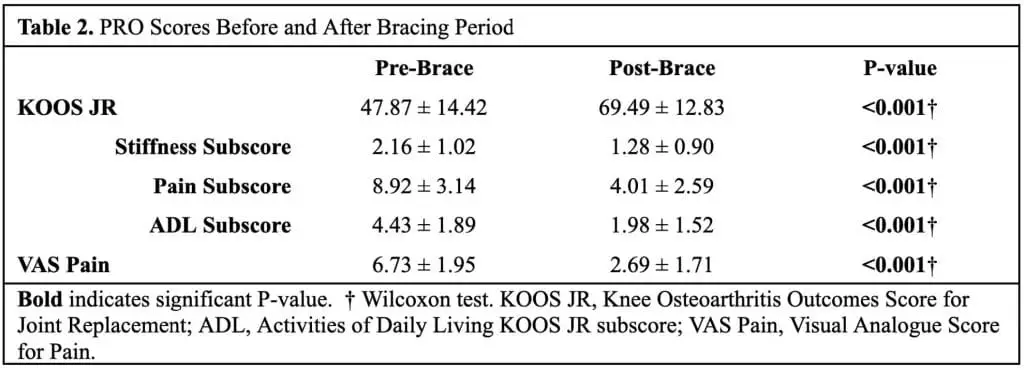
KOOS, JR. scores improved by an average of 21.62 ± 14.47 points (p<0.001), a 63.8% score improvement. 101 patients reported moderate or worse stiffness at the start of the study period, with 54.5% improving to mild or no stiffness. Patients who wore the brace at least four times per week saw the greatest stiffness subscore improvements. Similarly, 86.2% of patients with moderate or worse pain subscores reported pain reduction, and 81.9% of patients with moderate or worse functional subscores improved to mild or no functional deficits.
VAS Pain Scale
VAS (Visual Analog Scale) pain scores decreased by 4.04 ± 2.10 points (p<0.001), a 59.2% score improvement.
Discussion:
The results of this study demonstrate that patients with patellofemoral OA (both isolated and multicompartmental) can benefit both symptomatically and functionally from a patellofemoral unloader. The improvements in KOOS, JR. and VAS pain scores are clinically significant and highlight the viability of bracing as a successful, conservative treatment option.
This study adds to the limited literature focusing specifically on PFOA. The mechanism of Icarus Medical’s Ascender knee brace, by providing dynamic quadriceps unloading during knee flexion, addresses biomechanical challenges unique to the patellofemoral joint. The brace provides variable and dynamic extension assistance, reducing quadriceps activation and transferring load from the knee joint to the brace frame. This substantially reduces the pressure observed in the patellofemoral compartment (and medial and lateral tibiofemoral compartments). By mechanically reducing joint stress, the brace offers a targeted approach to managing pain and improving mobility.
Notably, higher compliance rates were associated with greater improvements in outcomes, emphasizing the importance of patient adherence in achieving therapeutic benefits. The high compliance and frequent use of the brace during the study (with 56.9% of patients wearing it at least 4 times weekly) is promising, especially considering historical struggles with long-term patient compliance.9 It is worth noting that the brace used in this study was custom 3D printed to fit the specific size and shape of the patient’s leg—a likely contributor to the high compliance and consequential therapeutic benefits observed.
Despite the positive outcomes, the structure of the study has limitations. The absence of a control group and the reliance on self-reported data introduce potential biases. Additionally, the duration of the study (four weeks) limits the ability to assess long-term effects. Future research should explore long-term efficacy, randomized controlled trials, impact on medication use, and objective measures such as biomechanical assessments and gait analyses.
Conclusion:
The findings of this study highlight the efficacy of a custom patellofemoral unloader brace in alleviating symptoms of PFOA. Significant improvements in pain, stiffness, and functional outcomes, as reflected in KOOS, JR. and VAS scores, underscore the potential of this brace as a viable conservative treatment option. The high compliance rates achieved in this study, likely facilitated by the brace’s custom-fit design and innovative, custom 3D-printed construction, emphasize the importance of patient-centric approaches in medical device design. This study contributes valuable insights into the management of PFOA and demonstrates the transformative potential of modern bracing technologies in enhancing patient outcomes.
Bibliography:
- Deshpande, B. R. et al. Number of Persons With Symptomatic Knee Osteoarthritis in the US: Impact of Race and Ethnicity, Age, Sex, and Obesity. Arthritis Care Res. 68, 1743–1750 (2016).
- Cross, M. et al. The global burden of hip and knee osteoarthritis: estimates from the global burden of disease 2010 study. Ann. Rheum. Dis. 73, 1323–1330 (2014).
- Hart, H. F., Stefanik, J. J., Wyndow, N., Machotka, Z. & Crossley, K. M. The prevalence of radiographic and MRI-defined patellofemoral osteoarthritis and structural pathology: a systematic review and meta-analysis. Br. J. Sports Med. 51, 1195–1208 (2017).
- Duncan, R. C., Hay, E. M., Saklatvala, J. & Croft, P. R. Prevalence of radiographic osteoarthritis–it all depends on your point of view. Rheumatol. Oxf. Engl. 45, 757–760 (2006).
- Wernecke, C., Braun, H. J. & Dragoo, J. L. The Effect of Intra-articular Corticosteroids on Articular Cartilage: A Systematic Review. Orthop. J. Sports Med. 3, 2325967115581163 (2015).
- Petersen, W. et al. Biomechanical effect of unloader braces for medial osteoarthritis of the knee: a systematic review (CRD 42015026136). Arch. Orthop. Trauma Surg. 136, 649–656 (2016).
- Hart, H. F. et al. May the force be with you: understanding how patellofemoral joint reaction force compares across different activities and physical interventions—a systematic review and meta-analysis. Br. J. Sports Med. 56, 521–530 (2022).
- Chinkulprasert, C., Vachalathiti, R. & Powers, C. M. Patellofemoral Joint Forces and Stress During Forward Step-up, Lateral Step-up, and Forward Step-down Exercises. J. Orthop. Sports Phys. Ther. 41, 241–248 (2011).
- Squyer, E., Stamper, D. L., Hamilton, D. T., Sabin, J. A. & Leopold, S. S. Unloader Knee Braces for Osteoarthritis: Do Patients Actually Wear Them? Clin. Orthop. 471, 1982–1991 (2013).