
Abstract
Greater Trochanteric Pain Syndrome (GTPS) affects 10–25% of the general population and frequently results in Trendelenburg gait, a debilitating gait abnormality caused by insufficient hip abductor strength that forces patients to walk with significant pelvic tilt and, in many cases, rely on a cane for basic ambulation. Despite its prevalence, no hip orthosis currently exists that is specifically designed to address the biomechanical root cause of this condition. The Hypnos Abduction Assist Hip Brace by Icarus Medical is the first device of its kind — delivering active, adjustable abduction-assisting force to supplement a deficient gluteus medius and restore stable gait mechanics. Unlike traditional hip braces that only limit range of motion, the Hypnos provides a supplemental abduction moment calibrated to the patient’s body weight and force deficit, allowing the patient to maintain normal pelvic alignment during walking. Clinicians treating patients with GTPS-related gait dysfunction now have a non-surgical, prescription orthotic solution that targets the mechanical source of the problem rather than managing its symptoms.

Figure 1. The Hypnos Abduction Assist Hip Brace provides active, user-adjustable hip abduction assistance to supplement a deficient gluteus medius. (a) Brace fitted to a female patient. (b) Trendelenburg gait with inadequate pelvic stability. (c) Corrected gait demonstrating improved pelvic stability with adjustable abduction assistance.
Introduction
Hip injuries are among the most common conditions in all orthopedics. Of these injuries, the majority are caused by musculoskeletal deficiencies of the tissue surrounding the hip. Greater Trochanteric Pain Syndrome (GTPS) is the broad condition that encompasses a wide range of pathologies ranging from trochanteric bursitis, tightness of the iliotibial (IT) band (or weakness of any of the attached muscles), tendinitis, and even formal strains and tears of the hip abductors (Ilizaliturri et al., 2022). GTPS is known to affect between 10% and 25% of the general population, occurring most in women after age 40.
Most patients suffering from GTPS will present with local hip pain during walking, standing, or other daily activities that becomes worse when bearing significant weight. GTPS can result in gait abnormalities, the most prevalent of these symptoms being Trendelenburg gait, which occurs in individuals with insufficient hip abductor strength on the affected side. The malfunctioning of the gluteal abductors can cause the patient to walk with significant pelvic tilt, causing discomfort while walking. Trendelenburg gait may force the affected individual to use a cane to support themselves and provide adequate force to correct the irregularity (Gandbhir et al., 2024). Trendelenburg gait causes increased wear on the cartilage of the hip joint and leaves patients at increased risk of osteoarthritis.
The Hypnos Abduction Assist Hip Brace by Icarus Medical is designed to treat patients with Trendelenburg gait. While traditional hip braces only limit range of motion, the Hypnos provides an active abduction-assisting force to supplement a deficient gluteus medius and provide overall joint stability. The patient can adjust the amount of abduction assistance to their specific activity or condition.
The Math Behind Pelvis Biomechanics during Gait
This is a retrospective case series based on clinical recall and follow-up visits (no prospective protocol). Patients were selected based on clinical presentation of dorsiflexion weakness ± gait abnormality and were prescribed the HERMES AFO after discussion of alternatives. Fabrication was performed through standard orthotic channels.Patient follow-up occurred at the first post-delivery visit (typically scheduled after brace receipt) and, in some cases, additional visits. Outcomes were assessed subjectively via patient report and clinician observation of gait and assistive device use.
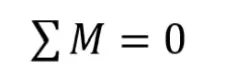
Stable walking gait is governed by Equation 1, which says that the sum of the moments acting on the hip joint must equal zero. Moment is the measure of the tendency of a force to rotate a body about a selected point, in this case the center of the hip joint. Moments are calculated as the product of the force and the perpendicular distance from the pivot.
(1)
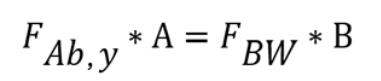
The two main sources of moment at the hip joint come from a patient’s body weight (FBW) acting at the midline of the pelvis, and the abductor muscle forces (FAB), mainly the Gluteus Medius and Gluteus Minimus, that counteract the body weight moment (Eq. 2, Figure 2, Left).
(2)
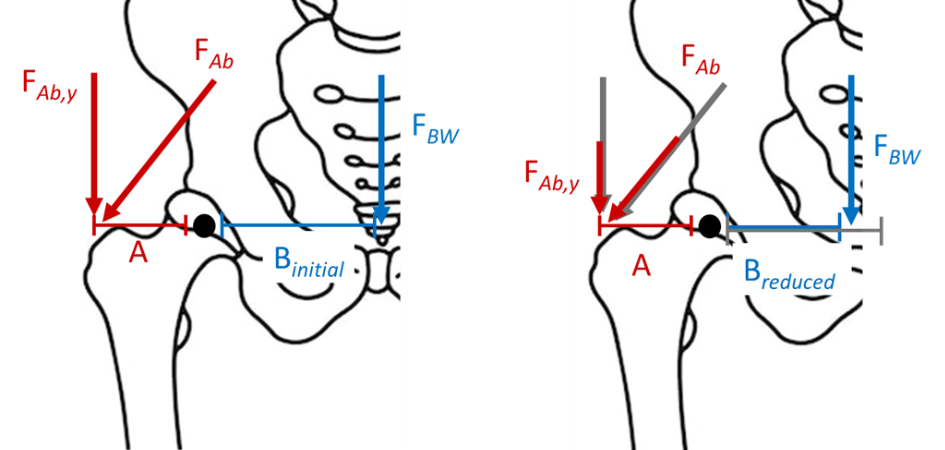
Figure 2: (Left) Free Body Diagram of hip joint, (Right) Free Body Diagram of hip joint in patient with Trendelenburg gait detailing reduced hip abduction forces and shifted body weight force
In healthy patients, the abductor muscles are strong enough to provide counteracting moment to their body weight. Patients with GTPS and Trendelenburg gait are unable to generate the large force required by their abductor muscles. In order to stay upright while walking, these patients will shift their weight toward the affected hip, shortening the moment arm of their body weight (Breduced) and thereby decreasing the moment required to stabilize their gait (Figure 2, right). This shifted body weight requires the patient to walk with significant pelvic tilt and is termed Trendelenburg gait.
The Hypnos brace works by providing active abduction-assisting force to supplement deficient Gluteus Medius and Gluteus Minimus forces. The force provided by the brace (FB) acts along the line of action of FAb. Patients wearing the Hypnos brace will have a larger abduction moment to counteract the moment caused by their body weight (Eq. 3), allowing them to keep their weight over the center of the pelvis (Figure 3).

(3)
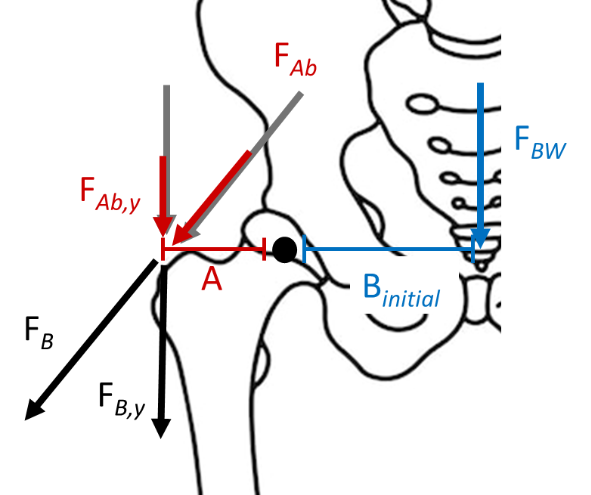
Figure 3: Free Body Diagram of hip joint in patient with Trendelenburg gait wearing Hypnos Brace
FBW varies widely across dynamic movements. When standing, FBW at the pelvis is estimated at 65% of a patient’s total body weight. During walking, FBW can increase to 100-150% of a patient’s body weight (Bergmann et al., 2001). The ratio of the body-weight lever arm to the abductor lever arm (B:A) is approximately 2.5:1.0 (Mirza et al., 2010). This means that in healthy patients during stable gait, FAb,y = 2.5 x FBW. Patients with weakened abductor muscles generate on average 80% of their healthy bilateral abduction force, FAb (Ismailidis et al., 2021, Valente et al., 2013). The Hypnos brace can provide up to 200 lb of in-line tension and is adjustable to a patient’s needs. The Hypnos brace’s adjustability makes it a solution for afflicted patients of all body weights and hip abduction force deficiencies (Table 1).
Table 1: Hypnos brace forces by body weight
| Patient Body Weight (lb) | FBW (lb) | FAb,y – Required (lb) | FAb,y – Deficient (80% of healthy) (lb) | FB,y (20% of FAb,y Required) (lb) |
| 100 | 100 | 250 | 200 | 50 |
| 150 | 150 | 375 | 300 | 75 |
| 200 | 200 | 500 | 400 | 100 |
| 250 | 250 | 625 | 500 | 125 |
| 300 | 300 | 750 | 600 | 150 |
FBW: Force due to body weight, FAb,y: Abductor muscle force, y-direction, FB,y: Brace force, y-direction
There is currently no other hip orthosis being produced specifically to correct the problem of Trendelenburg gait. In an area where no other solution is available (other than the cane), the Icarus Hypnos Abduction Assist Hip Brace will restore stable gait mechanics to many afflicted patients and set a new standard in the industry of hip bracing.
Patient Indications
The Hypnos Abduction Assist Hip Brace is indicated for patients presenting with hip abductor weakness and associated gait dysfunction. Ideal candidates include:
- Patients with a confirmed diagnosis of Greater Trochanteric Pain Syndrome who demonstrate Trendelenburg gait on clinical examination and have documented weakness of the gluteus medius or gluteus minimus on strength testing.
- Patients who are not yet surgical candidates and require a conservative, non-pharmacological intervention to improve functional mobility and quality of life while pursuing physical therapy or awaiting further clinical evaluation.
- Post-operative patients recovering from total hip arthroplasty (THA) who present with residual hip abductor weakness and gait instability, where supplemental abduction assistance may support rehabilitation and accelerate return to normal ambulation.
- Patients who currently rely on a cane or assistive device due to gait instability secondary to hip abductor insufficiency, for whom restoration of independent gait is a primary treatment goal.
- Patients across a broad body weight range (100–300+ lb) who require an adjustable level of abduction force support, as the Hypnos is calibratable to the specific force deficit of each individual patient.
- The Hypnos is not intended as a substitute for a comprehensive rehabilitation program. It is designed to work alongside physical therapy and clinical management to restore gait mechanics while the underlying condition is addressed.
References
Ilizaliturri, Victor M, et al. “Rehabilitation after Gluteus Medius and Minimus Treatment.” Arthroscopy, Sports Medicine, and Rehabilitation, U.S. National Library of Medicine, 28 Jan. 2022, www.ncbi.nlm.nih.gov/pmc/articles/PMC8811496/.
Gandbhir, Viraj N. “Trendelenburg Gait.” StatPearls [Internet]., U.S. National Library of Medicine, 29 Feb. 2024, www.ncbi.nlm.nih.gov/books/NBK541094/.
Bergmann, G, et al. “Hip contact forces and gait patterns from routine activities.” Journal of Biomechanics, vol. 34, no. 7, July 2001, pp. 859–871, https://doi.org/10.1016/s0021-9290(01)00040-9.
Mirza, Saqeb B, et al. “Basic science considerations in primary total hip replacement arthroplasty.” The Open Orthopaedics Journal, vol. 4, no. 1, 11 May 2010, pp. 169–180, https://doi.org/10.2174/1874325001004010169.
Ismailidis, Petros, et al. “Abductor muscle strength deficit in patients after total HIP Arthroplasty: A systematic review and meta-analysis.” The Journal of Arthroplasty, vol. 36, no. 8, Aug. 2021, pp. 3015–3027, https://doi.org/10.1016/j.arth.2021.03.042.
Valente, Giordano, et al. “Influence of weak hip abductor muscles on joint contact forces during normal walking: Probabilistic modeling analysis.” Journal of Biomechanics, vol. 46, no. 13, Sept. 2013, pp. 2186–2193, https://doi.org/10.1016/j.jbiomech.2013.06.030.