Healthy joints are essential for movement, whether you’re lifting at the gym, walking up the stairs, or carrying groceries. But when joints feel weak – whether from age, injury, arthritis, or inactivity – everyday tasks can suddenly feel like a challenge. The good news is that targeted exercises can strengthen the muscles around your joints, improve stability, and protect against future pain or injury.
This guide highlights some of the best exercises for building joint strength, with practical advice on how to use them safely and consistently.
Why Weak Joints Need Attention
Joints don’t exist in isolation. They rely on muscles, tendons, and ligaments for stability. When muscles around a joint are weak, the joint absorbs more force than it should, increasing the risk of overuse injuries and pain. Common culprits behind weak joints include:
Muscle imbalances
Sedentary lifestyle or long periods of sitting
Past injuries like sprains or ligament tears
Degenerative conditions such as arthritis
By strengthening the surrounding muscles, you create a supportive “brace” for the joint itself – one that reduces strain and improves function.
General Principles for Joint-Strengthening Exercises
Before jumping into the exercise list, a few guidelines will help you train safely:
Warm up first. Light cardio and mobility drills prepare the body and reduce injury risk.
Use proper form. Bad mechanics can put more stress on joints. If in doubt, start with bodyweight and progress slowly.
Start small. Begin with 2–3 sets of 10–12 reps, adjusting resistance gradually.
Listen to your body. Mild discomfort is okay, but sharp pain is a sign to stop.
Top Exercises for the Ankles
There are many potential exercises to include in one’s routine to strengthen the ankles better; here are the most integral.
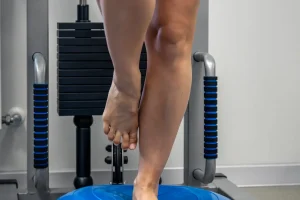
Calf Raises
Stand with feet hip-width apart and slowly lift your heels off the floor, then lower back down. This strengthens the calves and Achilles tendon while improving ankle stability.
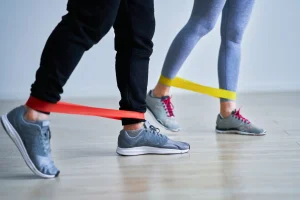
R-Band Inversion & Eversion
With a resistance band anchored, move your foot inward (inversion) or outward (eversion) against the band. These are particularly helpful for preventing ankle sprains by training stabilizing muscles.
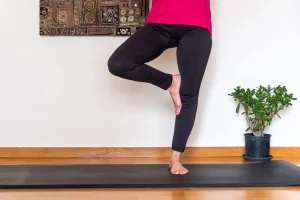
Single-Leg Balance
Simply standing on one leg for 30–60 seconds builds proprioception – the body’s awareness of position in space – which is vital for ankle health. To progress, try balancing on an unstable surface like a cushion.
Top Exercises for the Knees
There are many potential exercises to include in one’s routine to strengthen the knees better; here are the most integral.
Step-Ups
Using a sturdy bench or step, step up with one leg and bring the other leg to meet it. Alternate sides. Step-ups build quad and glute strength, key players in protecting the knees.
Wall Sits
Lean against a wall with knees bent at 90 degrees. Hold for 30–60 seconds. This isometric exercise strengthens quads without the stress of dynamic movement.
Glute Bridges
Lie on your back, bend your knees, and lift your hips off the ground. Glute strength helps keep the knees aligned during activity, reducing unwanted strain.
Top Exercises for the Hips
There are many potential exercises to include in one’s routine to strengthen the hips better; here are the most integral.
Clamshells
Lie on your side with knees bent, feet together. Lift your top knee while keeping your feet touching. This strengthens the gluteus medius, a critical stabilizer for both hips and knees.
Hip Thrusts
With your upper back supported on a bench, lift your hips upward with feet flat on the ground. Strong glutes protect the hips and reduce compensation in other joints.
Side Leg Raises
Lie on your side and lift the top leg upward. This builds hip abductor strength, helping with balance and reducing knee collapse during movement.
Top Exercises for the Shoulders
There are many potential exercises to include in one’s routine to strengthen the shoulders better; here are the most integral.
Wall Angels
Stand with your back against a wall and slowly raise your arms overhead while keeping elbows and wrists against the surface. This improves shoulder mobility and strengthens stabilizers.
External Rotations with Resistance Bands
Attach a resistance band to a fixed object. With the elbow bent at 90 degrees, pull the band outward. Strong rotator cuff muscles help stabilize the shoulder joint.
Scapular Squeezes
Pull your shoulder blades together as if pinching a pencil between them. This improves posture and reduces stress on the shoulder joint.
Putting It All Together
The best way to strengthen weak joints is to train consistently and with variety. Here’s a simple framework:
Choose 2–3 exercises per joint area you want to focus on.
Perform them 2–3 times per week, paired with a general workout routine.
Progress gradually by adding resistance, increasing holds, or introducing instability challenges.
This routine doesn’t just protect the joints – it also improves coordination, balance, and overall strength.
Additional Tools for Joint Support
Exercises should always be the foundation of joint health, but supports like braces can also help during activity. For example, a knee brace may provide comfort and alignment during long workdays or training. To learn more, check our related article “Using Knee Braces for Long-Term Support.”
Lifestyle factors like maintaining a healthy weight, eating an anti-inflammatory diet, and staying hydrated also play an important role in protecting joint integrity.
Building a Resilient Body
Weak joints don’t have to mean limited activity. By incorporating targeted exercises for ankles, knees, hips, shoulders, and wrists, you can create stronger, more resilient joints that handle daily life and exercise with ease. Start small, stay consistent, and remember: prevention is always easier than recovery.